
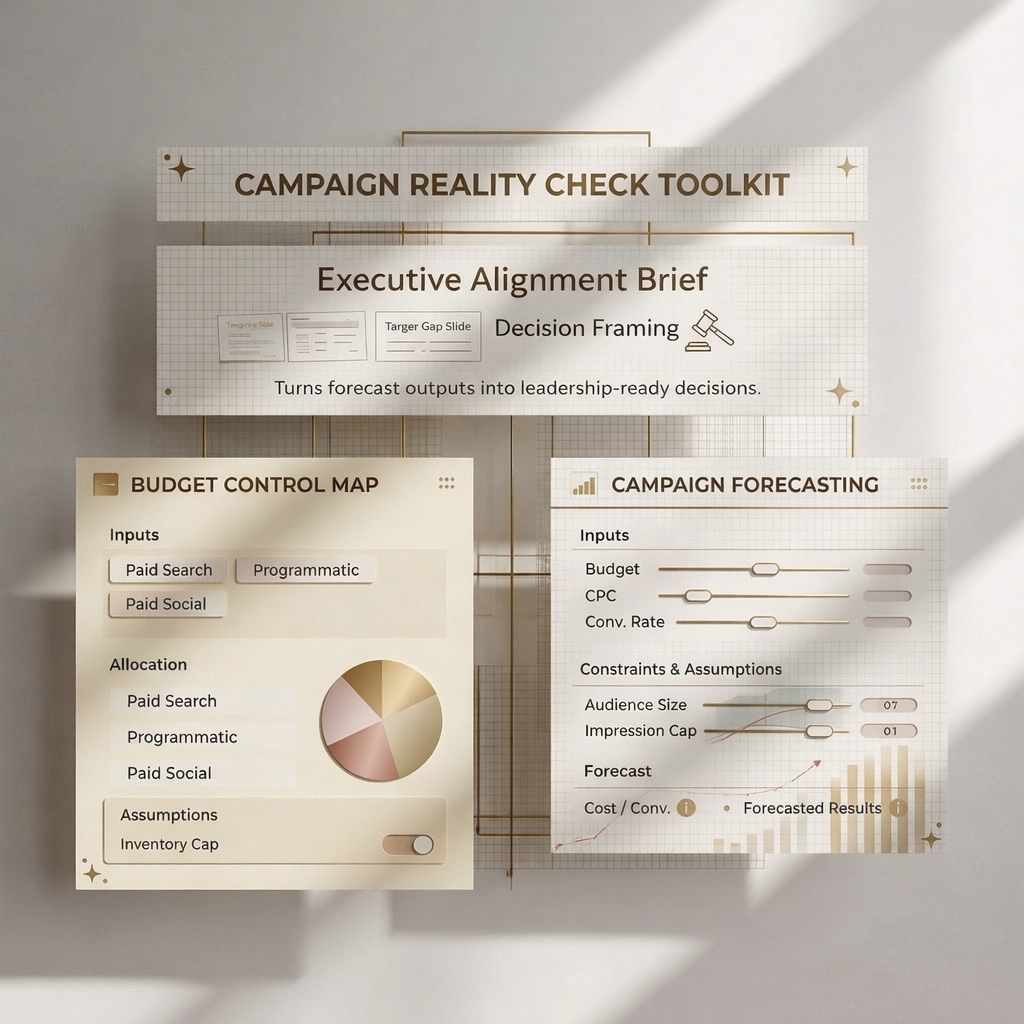
Campaign Reality Check Toolkit
The Planning System That Shows Whether Your Media Plan Actually Works - Before You Spend
Budget decisions. Performance outcomes. Executive decision clarity. Designed to work together as one planning system.
Optional Intelligence Layer available for guided decision support
Built from the same planning frameworks behind $300M+ in client revenue
Most marketing plans fail not because execution is poor, but because budgets and forecasts are disconnected - and decisions are made without understanding how they actually interact.
Most teams use separate tools and miss how those decisions compound.
Each tool answers a different question — without all three, the plan still breaks.
Using only one part of this system creates blind spots - the full toolkit is what makes the plan actually hold together.
Unlock the full planning system used to:
allocate budgets intentionally
understand where budget control structurally exists
test whether goals are actually achievable before money is spent.
align leadership on the right lever to pull
Most teams discover budget and forecast mistakes after launch. This system shows them before the budget is committed.
The difference isn’t more data — it’s knowing whether the plan actually works before you commit the budget.
Complete 3-part planning system · Works with any paid media campaign
$749 Core Toolkit
or $999 Toolkit + Guided Interpretation
— less than most teams misallocate before launchChoose the $999 version if you want structured help reading the outputs, identifying the planning constraint, and deciding what to review next.
Fully editable. No setup, subscription, or account required. You will review the full checkout details before confirming payment.

Not sure which version fits? Ask A Pre-Purchase Question: questions@sphericalstrategies.com. Send one sentence about the campaign, budget range, or planning decision. No sales call required.
“Once our strategy and targeting were aligned spending became more focused, performance improved, and our team operated with far more clarity and confidence.
We saw increased revenue, improved efficiency, and a clear competitive advantage ”
— Matt D., VP of Marketing, Multi-Location Brand
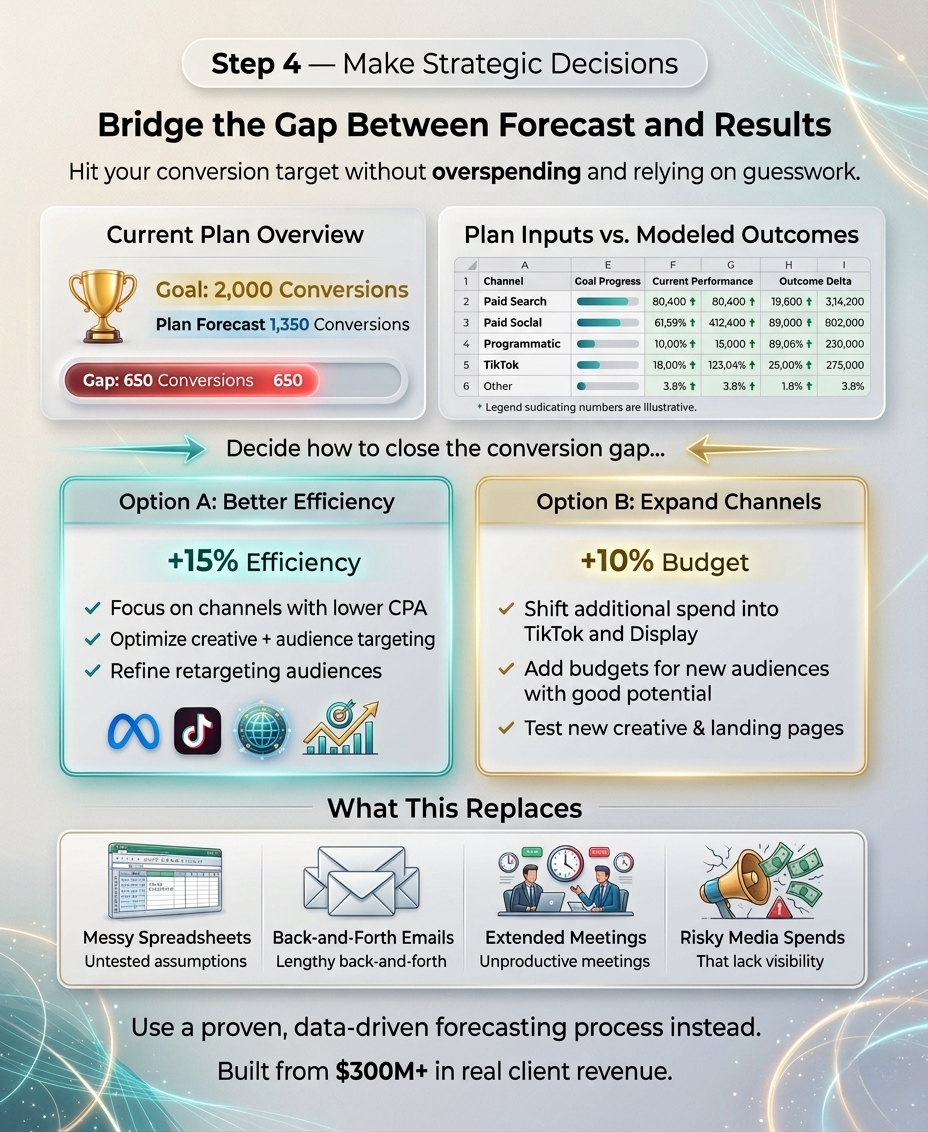
Where this system catches problems before they cost you
COMMON PLANNING SCENARIO
The $750K Mistake You Don’t Catch Until After Budget Approval
You’re finalizing a $4M media plan.
The numbers look right. The allocations are approved.
But buried in the assumptions is something no one questioned:
$750K in projected spend is based on efficiency that isn’t actually achievable.
No red flags. No reason to question it.
It looks fine in isolation — until you model the full plan.
Before the budget is locked:
You reallocate spend to channels that can actually deliver
You reset projected outcomes to reflect real performance
You walk into leadership with numbers that hold up under scrutiny
Without this system, you don’t find this mistake during planning.
You find it months later — after the budget is already spent and results don’t match the plan.
COMMON PLANNING SCENARIO
When Everyone Has an Opinion — and No One Has the Answer
You’re in a planning meeting.
Paid search wants more budget. Paid social wants more budget.
Everyone has data. No one agrees.
The decision still has to be made.
And whatever you decide will be questioned later.
The problem isn’t a lack of data — it’s that no one can show what actually drives results.
Using the system:
You separate fixed spend from what can actually be moved
You model how shifts impact real outcomes — not just channel performance
You walk into the room with a clear, defensible answer
Without this system, the decision defaults to opinion.
And whichever direction you choose — you can’t prove it was the right one — even if it was.
Why This Exists
The Problem
Planning breaks when teams ask these questions in isolation:
How should we allocate budget?
Can these goals actually be hit?
What decision are we actually making?
Budgets get built in one model. Forecasts live in another. Executive decisions happen in yet another room.
They rarely pressure-test each other.
When those systems aren’t connected, small assumptions compound — and misalignment only shows up after money is spent.
This isn’t a tooling problem. It’s a disconnect problem.
The Gap
Successful campaigns require:
A structural understanding of where budget meaningfully affects outcomes
A reality check on whether projected results are mathematically plausible
A clear translation of those tradeoffs into a leadership-ready decision
Most teams have one.
Very few have all 3 working together.
The Solution
This toolkit connects them.
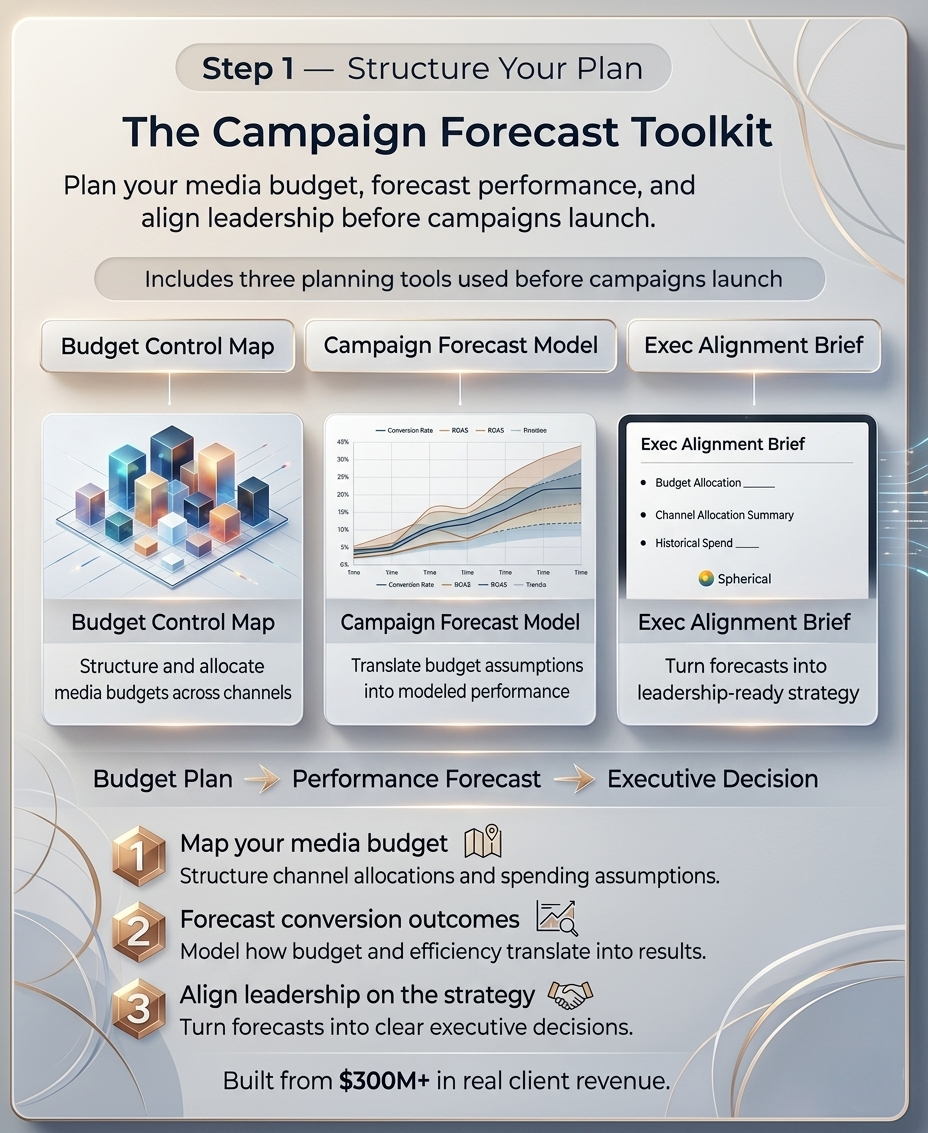
The Budget Control Map → shows where budget can meaningfully affect outcomes
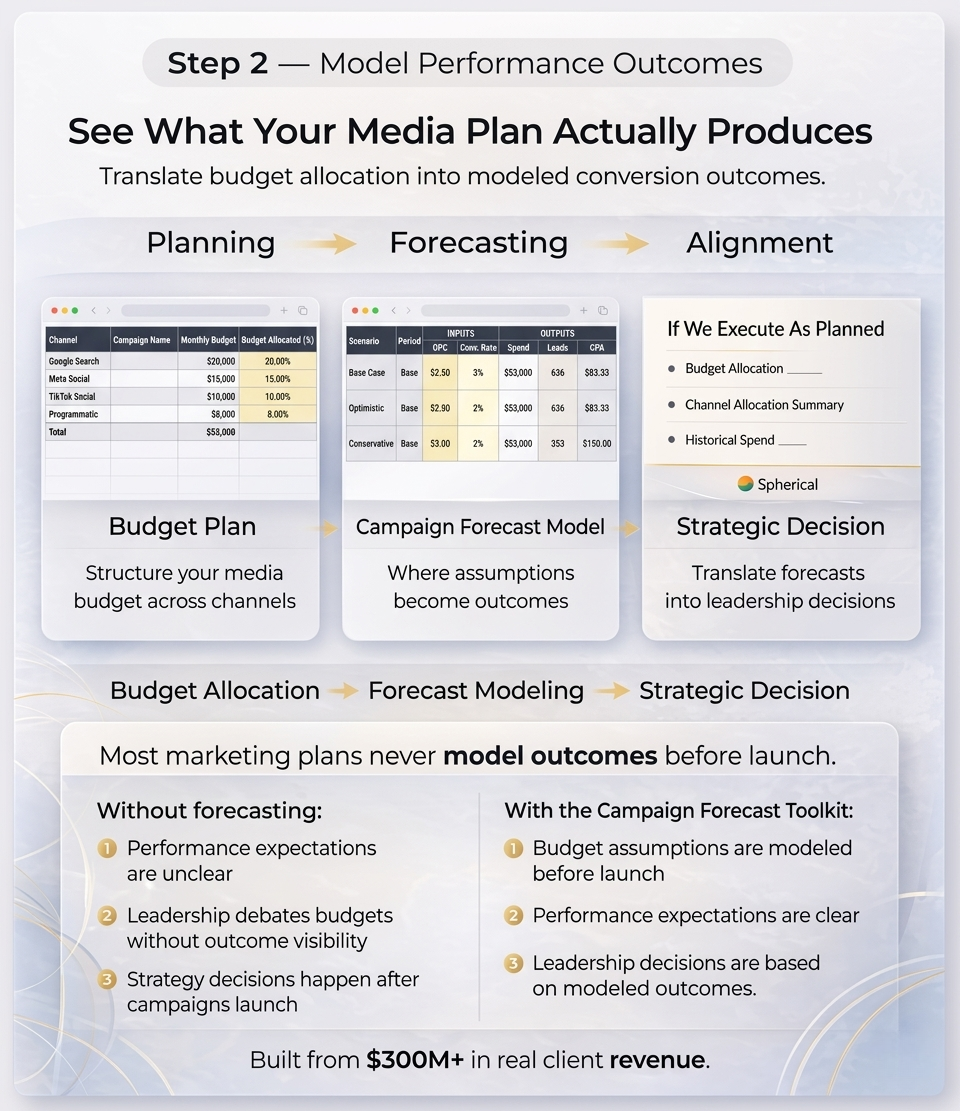
The Campaign Forecast & Reality Check → tests what those budgets can realistically produce
The Executive Alignment Brief → converts modeled outputs into a clear leadership decision
Individually, each tool solves a different planning failure. Together, they eliminate the gaps where bad decisions hide:
Plan budgets → understand control → test plausibility → drive aligned decisions
If results miss, you’ll know why in planning — before money is wasted.
What Each Part Solves
Budget Control Map
A structural budget mapping tool
Separates fixed vs. flexible spend
Shows where reallocations actually change outcomes
Identifies which budget shifts materially impact results
Designed to answer:
Which parts of this budget are meaningfully movable?
Where does shifting dollars change performance — and where does it not?
Campaign Forecasting & Reality Check
A planning and plausibility model
Translates assumptions into projected outcomes
Pressure-tests goals against real demand and funnel math
Surfaces unrealistic step-changes before money is committed
Designed to answer:
Are our stated goals mathematically achievable?
Where are projections relying on unrealistic assumptions?
What breaks first: volume, conversion rate, or budget?
Executive Alignment Brief
Adecision-framing presentation template
Converts modeled outputs into a leadership-ready decision
Clarifies which constraint is primary: budget, CPA, volume, or conversion rate
Frames tradeoffs transparently before commitments are made
Prevents planning conversations from reverting back to optimism
Designed to answer:
Given this modeled reality, what decision are we actually making?
Which lever are we choosing to pull?
What changes — and what does not — as a result?
Built from strategy systems developed by Jessica Behal and the Spherical team and used across $300M+ in client revenue.
“Jessica has a rare ability to connect high-level strategy with the underlying math and execution. She translates complex marketing decisions into something clear, structured, and actionable — which fundamentally changes how you plan.”
— Krystal P., Founder, Marketing Agency
What You Unlock
Built from the same planning frameworks used in multi-million-dollar media programs by a 7-figure agency, this system helps you unlock:
Structural clarity — which parts of the budget are actually movable (and which aren’t)
Plausible goal setting — grounded in math, not optimism
Constraint awareness — demand, volume, and conversion limits
Defensible planning conversations — with leadership and finance
Clear decision framing — what lever is being pulled, and why
Confidence before spend — not after performance disappoints
Knowing what to do next — not just what the numbers say
This is not about optimization.
It’s about seeing the plan clearly — and aligning on the decision — before execution begins.
Who This Toolkit Is For
This toolkit is built for:
marketing leaders accountable for outcomes
teams operating under executive or board pressure
budget owners questioning whether planned spend is sufficient
organizations planning campaigns before results are known
If you need to know — before execution — whether your budget, assumptions, and targets align, this system provides that clarity.
What This Toolkit Is Not
This toolkit is not:
a media plan
an attribution model
a performance optimization tool
a recommendation engine
a guarantee of results
It does not:
evaluate creative, targeting, or messaging quality
assign credit for indirect or “halo” effect
tell you which channels to increase or decrease
All insights describe structure and mathematical implications, not execution quality.
How It Works
Instant access to the complete system (3 Proprietary Google tools)
Make your own editable version on delivery
Input your assumptions (budget, demand, conversion rates)
Model realistic scenarios
Use the Executive Alignment Brief to present a leadership-ready decision
Historical performance anchors default assumptions
Inputs can be overridden as needed
Forecast outputs update automatically
Designed for transparency, traceability, and repeat use
No software. No setup. No subscriptions.
“Jessica’s depth of knowledge and structured approach stood out immediately. The strategy was clear, execution was aligned, and decisions were grounded in precision.”
—Lisa B., Sr. Associate Director of Marketing, Top 3 US Business School (Wharton)
If one wrong assumption costs six figures, this system pays for itself instantly.
One wrong assumption can cost more than this entire system.
You either catch it before launch — or you pay for it after.
This system pressure-tests your assumptions, allocation logic, and projected outcomes — before money is committed.
Works with any media plan · Built by a 7-figure agency · Three tools. One system. $149 savings.
Most teams only find out their plan is wrong after results miss.
By then, the budget is already committed — and harder to fix.
This system shows you where it breaks — before that happens.
Catch the mistake before it costs you.
Campaign Reality Check Toolkit
$749 one-time
or $999 with Intelligence Layer (AI-guided decision support)
Instant access after purchase. Fully editable. No setup or account required.
Enter your email -> secure checkout -> instant access
Not Ready to Buy Yet?
Run the free 30-second Revenue Plan Math Check before you purchase.
You’ll see exactly what your revenue goal actually requires — in traffic, leads, and budget.
No email or signup required. Just 6 quick inputs.
Common Questions Before You Buy
-
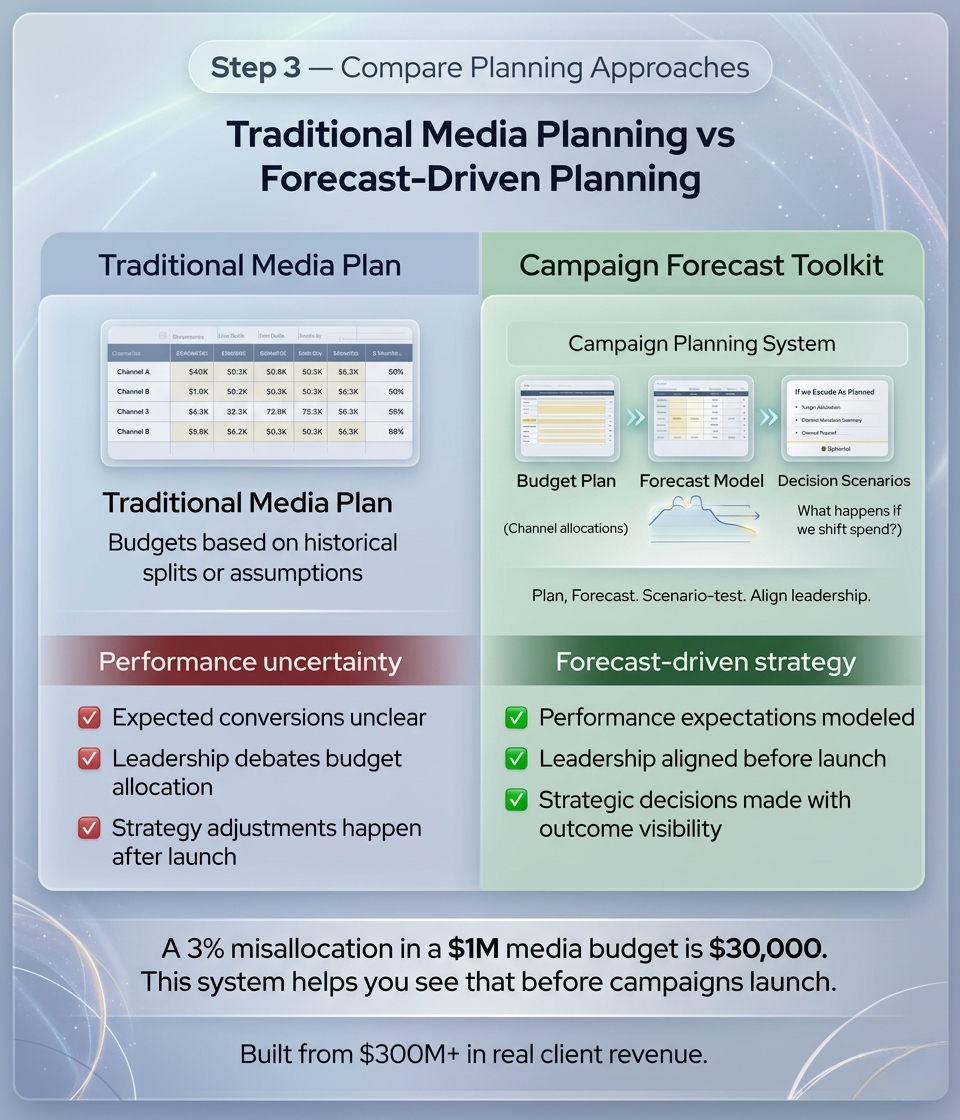
If a 3% planning mistake costs $60K–$150K, $749 becomes irrelevant.
On a $2M budget, a 3% misallocation is $60,000. On $5M, it’s $150,000. These errors don’t come from execution—they come from planning assumptions that were never pressure-tested.
This toolkit is built to catch those gaps before spend goes live.
It packages the same planning logic used in six- to eight-figure media programs into a set of tools you can apply directly to your own budget.
Individually, the components total $898. The bundle is priced at $749 and includes the Executive Alignment Brief, which turns your outputs into leadership-ready decisions.
For teams accountable to revenue, the cost of clarity is small compared to the cost of guessing—and the impact compounds quickly once assumptions are aligned.
-
Yes — but it’s not a black-box or automated optimizer.
The Intelligence Layer uses AI to guide decision-making in a structured way — helping you pressure-test assumptions and identify what to change before budget is committed.
It works with your inputs, your plan, and your constraints.
It’s built specifically around this planning system — not a generic tool, but a structured layer designed to pressure-test real decisions.
It’s designed to support how experienced operators actually think through decisions — not shortcut them.
It doesn’t generate answers for you or replace your judgment — it strengthens it.
It helps you see where your logic breaks — so you can make better decisions with confidence.
-
You don’t need perfect data to use this.
If you can connect your spend to outcomes—even roughly—you can start. You do need a few core inputs to use the tools—but most teams already have them.
At a basic level, you’ll need:
Spend by channel or campaign
Conversions or outcomes
A way to estimate efficiency (CPA, conversion rate, or similar)
That’s enough to pressure-test whether your plan actually works.
If you have more detailed data—like CPCs, volume caps, or stage-to-stage conversion rates—you can layer that in for more precision.
You don’t need perfectly clean or fully built-out reporting. The tools are designed to work with structured assumptions, so you can start with what you have and refine from there.
The goal isn’t perfect inputs—it’s better decisions.
-
No.
These tools are built for marketing leaders and performance operators—not data engineers.
If you’re comfortable reviewing performance metrics (like CPA, conversion rates, or targets) and making budget decisions in a spreadsheet, you’ll be able to use them effectively.
The formulas and modeling logic are already built in—you’re applying judgment, not building the model.
-
Many teams complete an initial pass in a single sitting—often within a few hours.
Most can get a single tool up and running in 1–2 focused sessions once their data is accessible. If you’re using the full toolkit across multiple channels or scenarios, expect 2–4 sessions to align inputs and assumptions.
There’s no technical setup required—the timeline depends on how quickly you can align on your numbers, not on configuring the tool.