

Most plans look right - until they hit reality
This shows where your plan breaks - before money is committed.
Powered by an intelligence layer that pressure-tests your assumptions against real planning constraints.
Used by teams managing multi-channel budgets to validate assumptions before launch.
Built from the exact forecasting models used behind $300M+ in client revenue.
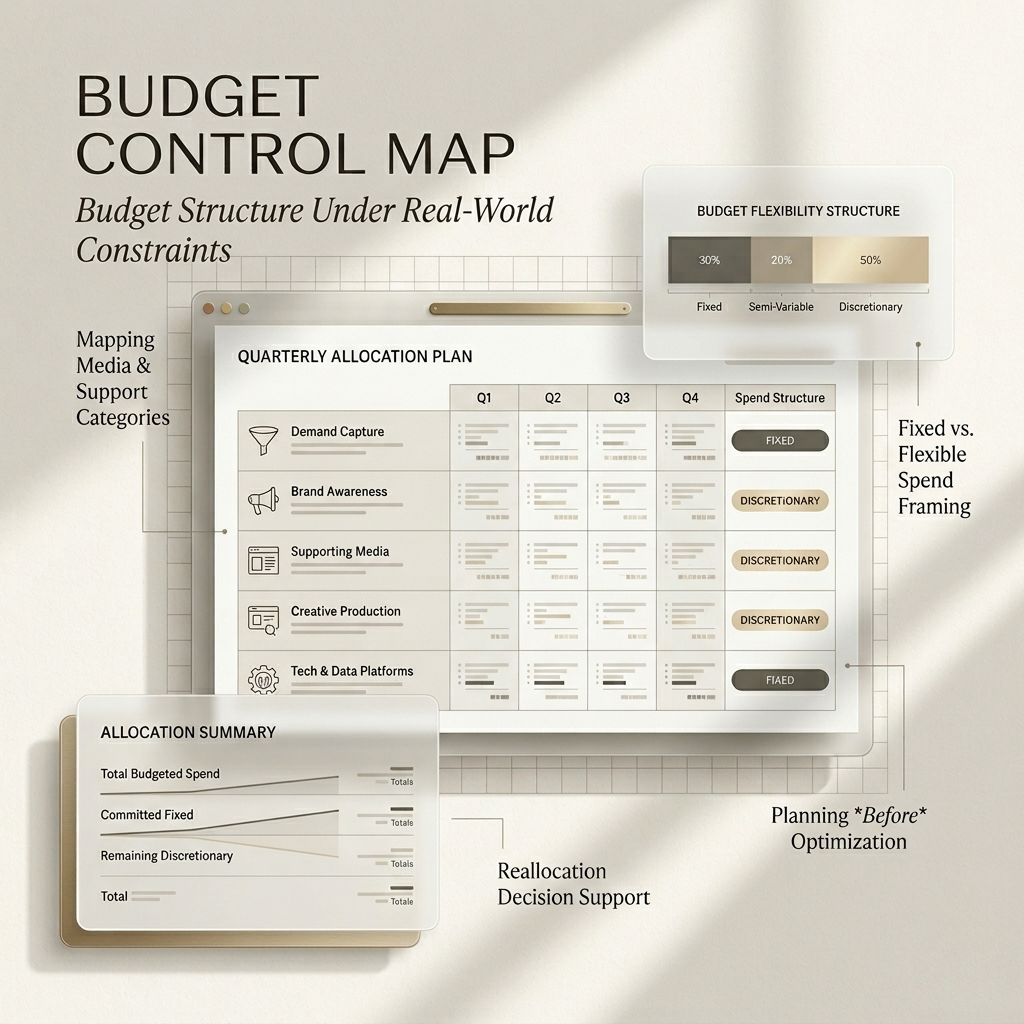
Budget Control Map
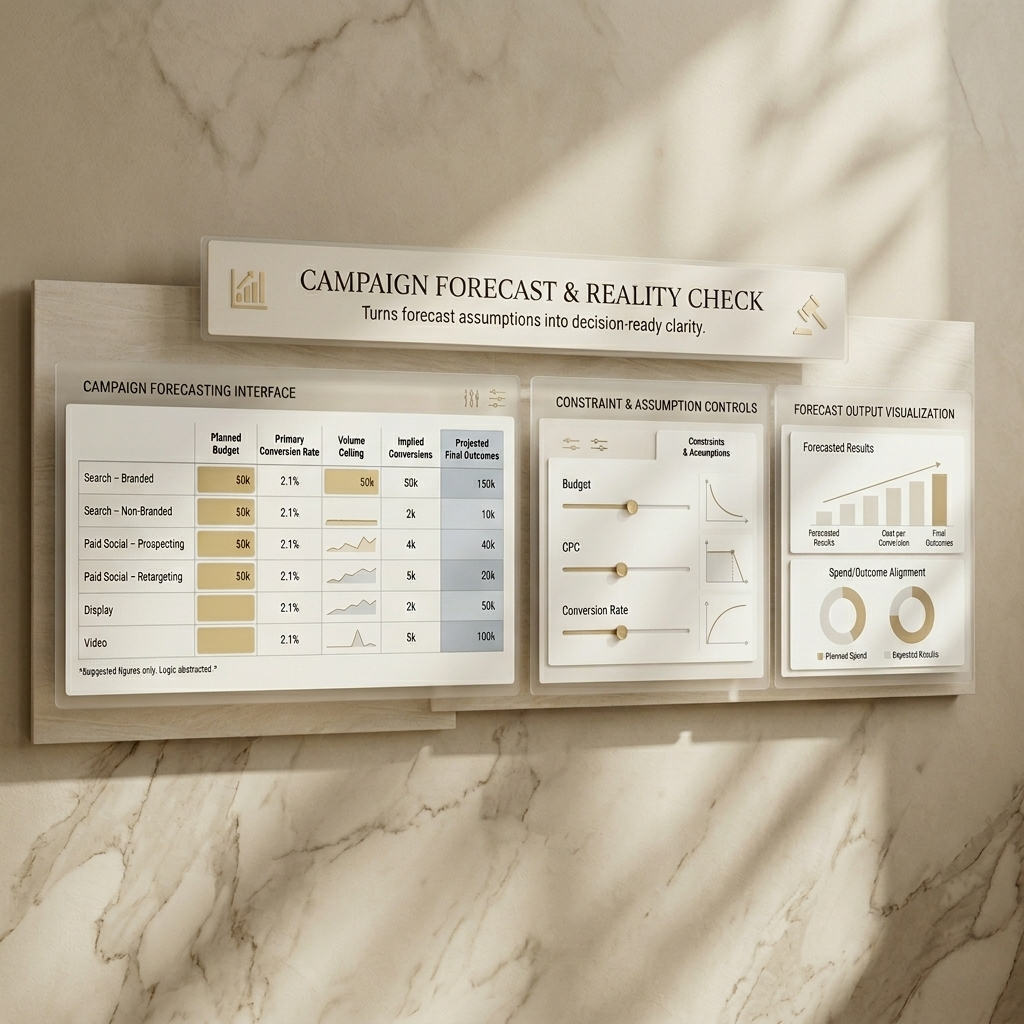
Campaign Forecast & Reality Check

Executive Alignment Brief
Choose the decision you need to make.
Each tool is built for a different planning moment - start where you’re stuck.
Budget Control Map
Use this when:
You need to see where budget allocation actually exists
You need to understand what’s fixed vs. flexible
You’re preparing for conversations about overspend or inefficiency
You want structure before optimization
Campaign Forecast & Reality Check
Use this when:
You’re validating assumptions before launch
You need to pressure-test projected performance
You want to expose trade-offs before money is committed
You need to know if your forecast actually holds.
Full Toolkit
Use this when:
You’re managing budgets across multiple channels
Forecasting and allocation decisions must connect
You need visibility across structure, assumptions, and trade-offs
You want one system governing the entire spend model.
Optional - add Intelligence Layer for guided decision support

Most teams don’t realize they need both until after something breaks.
Not sure which one you actually need?
Here is how they differ - and what each one solves.
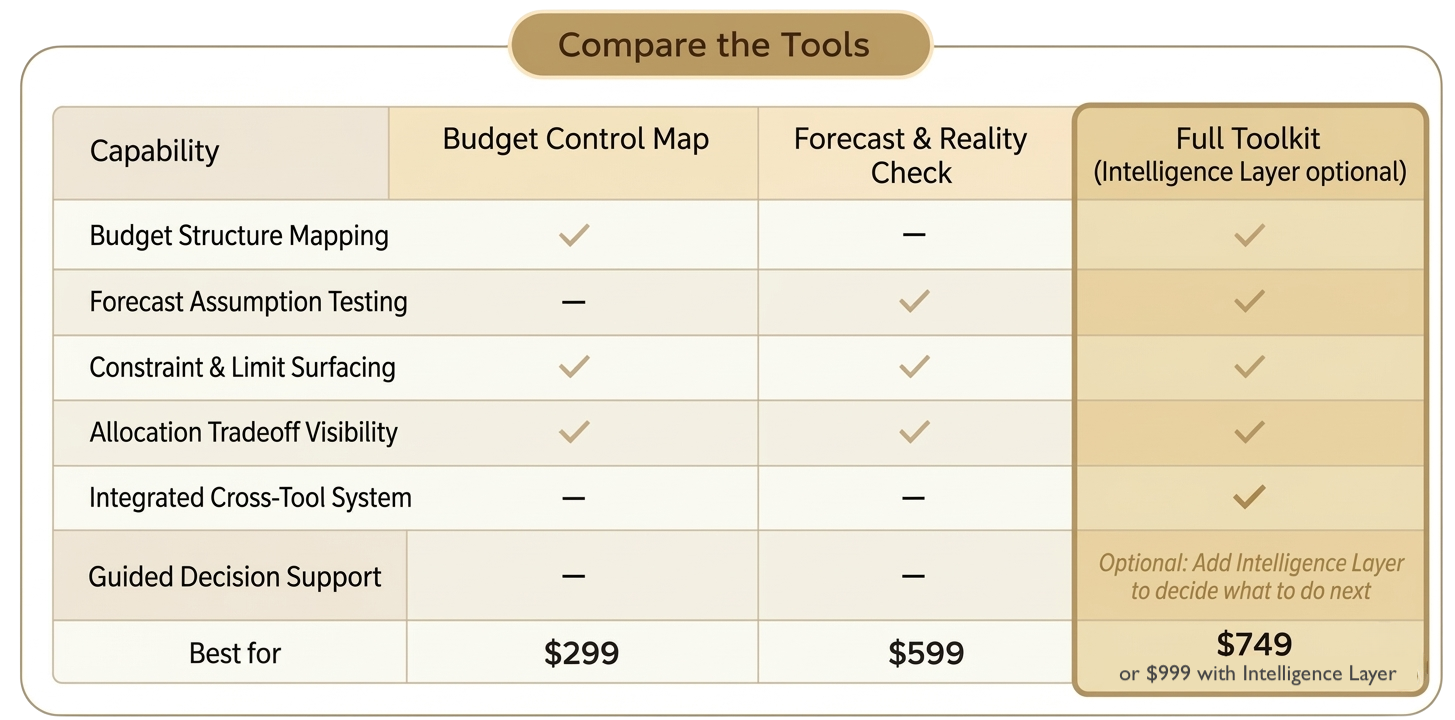
If you’re deciding between the tools, you’re likely already dealing with both structure and performance - which is why most teams choose the full toolkit.
Built from real-world planning models - not theory.
These tools are based on the same forecasting and budget structuring models used to build over $300M in client revenue across multi-channel environments - built by a 7-figure operator working inside large-scale, multi-channel growth environments.
Used in environments with real constraints - not ideal scenarios
Built to expose trade-offs, not hide them
Designed for teams making decisions before budget is committed
Structured for clarity across stakeholders, not just analysts
This isn’t a template, It’s a decision system built to hold under real budget pressure.
Built from hands-on work managing multi-million dollar budgets across higher education, corporations and complex acquisition funnels.
Used by teams responsible for multi-million dollar budgets where decisions carry real financial consequences.
“Once our strategy and targeting were aligned spending became more focused, performance improved, and our team operated with far more clarity and confidence.
We saw increased revenue, improved efficiency, and a clear competitive advantage.”
— Matt D., VP of Marketing, Multi-Location Brand
Questions before you commit
-
If a 3% planning mistake costs $60K–$150K, $749 becomes irrelevant.
On a $2M budget, that’s $60,000. On $5M, it’s $150,000. These errors don’t come from execution—they come from planning assumptions that were never pressure-tested.
This toolkit is built to catch those gaps before spend goes live.
It packages the same planning logic used in six- to eight-figure media programs into a system you can apply directly to your own budget.
Individually, the components total $898.
The bundle is priced at $749 and includes the Executive Alignment Brief, which turns your outputs into leadership-ready decisions.For teams accountable to revenue, the cost of clarity is small compared to the cost of guessing—and the impact compounds quickly once assumptions are aligned.
-
No — but it is structured.
These tools are designed for teams making real budget decisions, not casual exploration. That said, they don’t require advanced modeling skills or technical expertise.
Each tool is built to guide you step-by-step through the inputs, with clear logic and defined outputs.
If you understand your budget, your channels, and your outcomes, you can use this.
The complexity isn’t in using the tools — it’s in the decisions they help you make.
But you don’t need to figure this out on your own — the Spherical Intelligence Layer is built into the system to guide how you think through decisions. It’s not a generic AI tool or automated optimizer — it’s structured around the exact planning logic inside the models.
-
Most teams do — and most haven’t pressure-tested it.
These tools don’t replace your model. They expose where it breaks.
The Forecast & Reality Check is specifically designed to validate whether your assumptions actually hold under real constraints.
In many cases, teams use this alongside their existing models to identify gaps, misalignments, or overly optimistic projections.
If your current plan is solid, this will confirm it.
If it’s not, this will show you where — before budget is committed. -
Yes — because it’s not tied to specific platforms.
The system is built around how budgets translate into outcomes across any multi-channel environment: paid search, paid social, display, video, affiliate, programmatic, and more.
The logic focuses on relationships between spend, traffic, conversion, and outcomes — not platform-specific tactics.
If your budget spans multiple channels (or even one with meaningful scale), this applies.
-
You get three integrated components with the Toolkit:
Budget Control Map (Google Sheets)
A structured view of where your budget is fixed, flexible, and sensitive — so you can see what can actually be changed.
Campaign Forecast & Reality Check (Google Sheets)
A model that tests whether your assumptions hold — and shows where your plan breaks under real conditions.
Executive Alignment Brief (Google Slides)
A presentation layer that translates your outputs into clear, decision-ready communication for leadership.
Together, these form a system — not just individual tools — designed to help you move from planning to aligned execution.
-
This is built for:
Teams managing six- to eight-figure marketing budgets
Operators responsible for hitting revenue targets
Organizations making multi-channel investment decisions
Leaders who need clarity before committing spend
If you’re responsible for how budget translates into outcomes, this is for you.
-
This is not designed for:
Beginners learning marketing fundamentals
Teams looking for optimization tactics or platform strategies
Very small budgets where planning precision has minimal impact
Anyone looking for a “plug-and-play” or automated solution
This is a decision system — not a shortcut.
A $2M annual budget off by just 5% =
$100,000 misallocated before results even come in
What small planning errors actually cost
A $500K channel forecast that’s 20% too optimistic =
$100K gap between expected and actual performance
Retargeting scaled without enough prospecting = efficiency looks strong while growth quietly stalls
Most teams don’t catch this until after spend.
This is built to catch it before.
Most plans look right — until they’re tested.
This is what teams use when they need to validate before committing real budget.
The difference isn’t execution - it’s whether your assumptions hold.
If your plan hasn’t been stress-tested, you’re guessing.
If this isn’t validated before budget is committed, mistakes get locked in.
Instant access after purchase. Fully editable. No setup or account required.
Enter your email - secure checkout - instant download
Full Toolkit - $749 / $999
Everything needed to validate before budget is committed. (Includes both tools & Executive Alignment Brief)
Add the Intelligence Layer to guide decisions, not just generate outputs.
Forecast & Reality Check - $599
Test whether your plan actually holds
Budget Control Map - $299
Understand where your budget actually lives